30A commercial kitchen is a dedicated food preparation area where restaurants, cafes, hotels, bakeries, catering businesses, and cloud kitchens carry out their daily operations.
Unlike a residential kitchen, commercial kitchens can manage high food volumes, equipment, high staff volume, and demanding service schedules.
A well-planned commercial kitchen setup helps to improve kitchen workflow, hygiene, service quality, safety, and productivity.
Creating an efficient commercial kitchen is more than purchasing commercial kitchen equipment. Rather businesses should carefully plan every aspect of commercial kitchens such as kitchen design, kitchen layout, food preparation spaces, food storage, refrigeration, cooking stations, cleaning facilities, plumbing, electrical systems, ventilation, and fire safety.
An effective commercial kitchen layout reduces unnecessary movement and allows staff to work smoothly and efficiently during peak business hours. Also implementing proper commercial kitchen ventilation is essential to reduce heat, smoke, grease, and cooking odors.
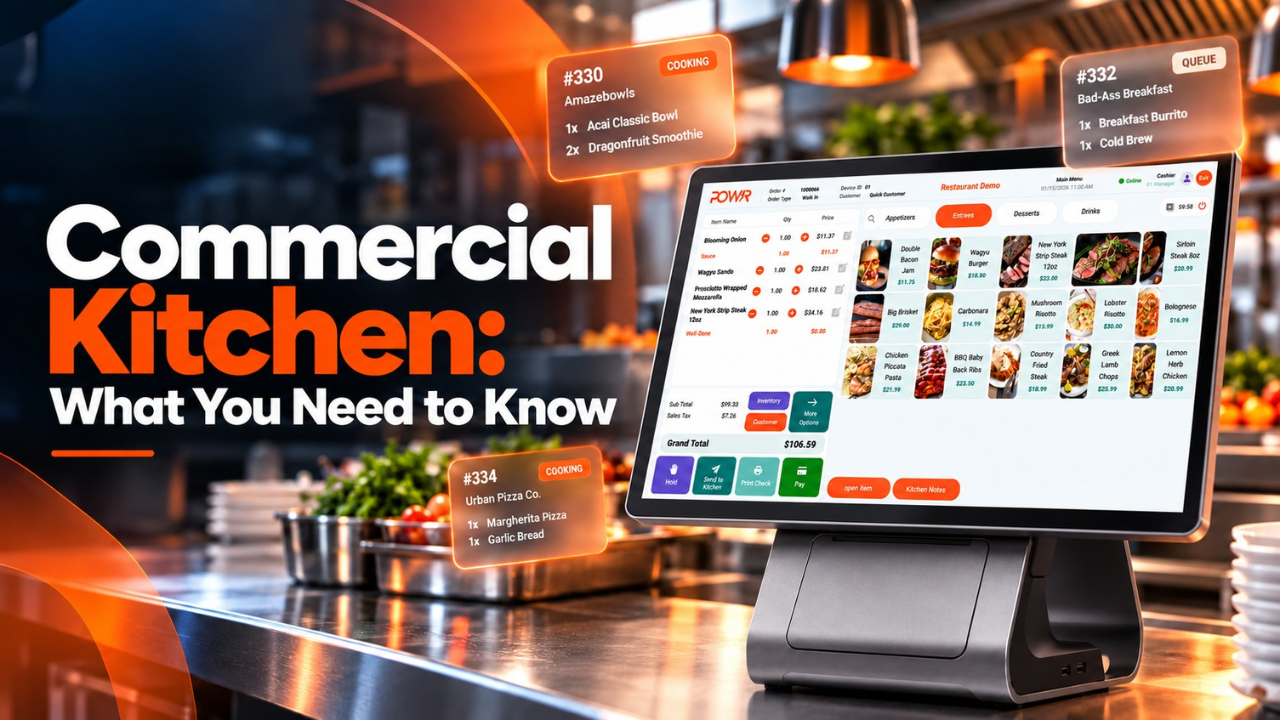
Using modern technology in commercial kitchens helps to improve food-service operations. POWR POS helps restaurants to manage orders, payments, inventory, online ordering, kitchen workflows, and reporting through connected systems. Its Kitchen Display Systems helps to coordinate incoming orders and improve communication between front office and kitchen staff.
Through this blog, we will explain commercial kitchens, different types of commercial kitchens, important commercial kitchen equipment, kitchen safety, food safety, and kitchen workflow.
We will also walk you through commercial kitchen costs, technology, and practical tips for creating an efficient, scalable, and productive professional kitchen successfully.
Also Read: ThanksGiving Restaurant Guide Whats Opens
What Is a Commercial Kitchen?
A commercial kitchen is a professional food preparation space to prepare food and to serve it safely to customers or other food services. Commercial kitchens are built to handle consistent, high-volume food production with separate spaces assigned to specific kitchen operations.
-
Receiving ingredients
-
Dry and cold storage
-
Food preparation
-
Cooking
-
Baking or specialized production
-
Plating
-
Packaging
-
Dishwashing
-
Waste management
-
Food dispatch
The commercial kitchen setup that businesses choose may depend on the requirements of the business. For instance, a small cafe may require a small kitchen with less kitchen equipment.
While a hotel or central production kitchen may require several cooking lines, large refrigeration systems, high storage space, and specialized food preparation spaces.
A commercial kitchen is defined by how well it meets the needs of businesses and not just by size. They may require professional equipment, good workspace, enough space to prepare food, proper hygiene, safety measures, and smooth daily operations.
A residential kitchen is built around a household. For building a commercial kitchen, businesses should plan well to ensure that they are able to manage ingredients, staff, equipment, orders, prepared food, dishes, and food waste.
Also Read: Labour Day Deals Restaurant Promotions to attract More Customers
Why Is a Commercial Kitchen Important?
Commercial kitchens play an important role in a food business as it affects the way food is served, its food quality, overall expenses, and consistency. Because during busy hours, even if there is a small workflow problem can cause delays in the overall operations.
A properly planned commercial kitchen can help businesses:
-
Prepare larger quantities of food efficiently
-
Reduce unnecessary staff movement
-
Improve order accuracy
-
Maintain consistent food quality
-
Organize ingredients and equipment
-
Reduce food waste
-
Improve workplace safety
-
Make cleaning easier
-
Support faster service
-
Handle peak demand more effectively
Through commercial kitchens businesses can also maintain food-safety standards professionally. They should ensure that the layout and equipment installed should be appropriate for preparing food, cleaning, storage, temperature control, and waste management.
Due to this reason, planning of kitchens should start before major construction or equipment purchases. Finalizing the kitchen layout before purchasing equipment is essential because making changes to gas lines, drainage, electrical connections, or placing equipment later can be expensive.
Also Read: Food Truck Names 100+ Creative Names
Types of Commercial Kitchens

For different types of food businesses, there are different types of food production requirements. Choosing the right type of kitchen planning to implement before the kitchen setup helps to choose the right layout, equipment, staffing, and budget.
1. Restaurant Kitchen
These kitchens prepare food for dine-in, takeaway, and delivery orders. Their layout and equipment of such kitchens is based on the food menu, cuisines, customer visits, and food preparation methods.
It may include:
-
Preparation stations
-
Cooking lines
-
Refrigeration
-
Dry storage
-
Plating areas
-
Dishwashing
-
Order dispatch
2. Cloud Kitchen
In cloud kitchens food is prepared for delivery and takeaway orders. They do not require a dining space, rather allocate spaces for food preparation, cooking, packaging, storage.
From a single food preparation facility, cloud kitchens prepare food for several food brands. In such cloud kitchens appropriately utilization of space, organized workflows, using the right equipment for handling multiple orders.
3. Bakery Kitchen
Bakery kitchens produce food items like bread, cakes, pastries, and cookies. They require specialized equipment for preparing dough, baking products, cooling them before serving or packaging.
Common equipment includes:
-
Planetary and spiral mixers
-
Dough sheeters
-
Proofers
-
Commercial ovens
-
Cooling racks
-
Refrigeration
-
Stainless-steel worktables
4. Hotel Kitchen
Such a kitchen produces food for restaurants, room service, buffets, banquets, conferences. Hotel kitchens prepare food for many guests at different times.
These kitchens require several food preparation and cooking spaces, more storage capacity, refrigeration, and specialized equipment.
5. Catering Kitchen
These kitchens prepare food in large quantities for weddings, parties, corporate events, and other functions. In such kitchens, food is prepared in advance, packaged, and served at multiple locations.
These kitchens generally require:
-
High-capacity cooking equipment
-
Large storage areas
-
Food-holding equipment
-
Preparation space
-
Packaging supplies
-
Transportation containers
6. Institutional Kitchens
These kitchens are run by schools, hospitals, colleges, and offices. Institutional kitchens prepare food in high amounts as per planned menus and recipes.
Such kitchens prepare food in batches, focus on hygiene, food portion control, safe food storage, and food distribution. Also efficient staff scheduling and consistently preparing food is important in such kitchens as they serve large groups.
7. Central Kitchen
Central kitchens prepare food and distribute it to several restaurants, outlets, stores. Such kitchens improve consistency of services, and make simple food production simple across different branches.
Central kitchens may require:
-
Substantial refrigeration
-
Storage and preparation areas
-
Packaging facilities
-
Inventory management
-
Quality control
-
Transportation capabilities
Such requirements help central kitchens to maintain food preparation consistently and also efficiently supply food to multiple locations.
Also Read: Thanks Giving Restaurant Ideas Whats Open
How to Plan a Commercial Kitchen
Planning a commercial kitchen should begin with understanding the requirements of businesses or food dishes that they want to prepare.
While planning businesses have to consider their food menu, number of customer visits, staff requirements, food preparation methods, food storage requirements, and kitchen workflow before buying kitchen equipment.
Important questions to answer include the food items they want to include in the menu, number of expected customers, and the expected busy hour orders, the number of staff expected to work at the same time, food preparation methods and refrigeration required, storage space required, ingredients levels, the way dishes will be washed and waste collected.
The food menu decided for the commercial kitchen guides about the equipment they require when businesses have different requirements. For example, a bakery, pizza restaurant, cloud kitchen may need different kitchen requirements and service spaces. They may also have to plan layout before installing gas, electricity, water, drainage.
How to Set Up a Commercial Kitchen: A Complete Guide

1. Plan an Efficient Commercial Kitchen Workflow
Planning an efficient commercial kitchen workflow is essential as this step ensures that ingredients, staff, food, dishes, and food waste is well maintained between different work areas.
This step helps to avoid unwanted movement of resources and allows staff to work efficiently even during busy hours.
A usual food movement sequence is:
-
Receiving
-
Storage
-
Preparation
-
Cooking
-
Plating or packing
-
Service or dispatch
They must maintain food storage spaces well so ingredients are moved easily without interrupting food preparation or cooking. They should also plan cleaning and waste spaces separately.
2. Choose the Right Commercial Kitchen Layout
The next step is to select the right commercial kitchen layout based on the space, food menu, number of staff, equipment, customer traffic, and production process. As different kitchen layouts support different types of food businesses.
Common options include:
-
Assembly-line layout: in this layout food workstation arrangements are arranged in a sequence like food preparation, cooking, assembly, packaging, and dispatch.
-
Zone layout: in this layout kitchen is divided into spaces for food preparation, food cooking, baking, storage, washing, plating, and packaging.
-
Island layout: this layout involves placing a cooking station in the middle of the kitchen.
-
Galley layout: in this layout equipment is placed on two sides, which makes it useful for narrow spaces.
-
Open kitchen layout: in this layout customers are considered to be part of the food preparation process but need to maintain cleanliness and organization.
3. Select Essential Commercial Kitchen Equipment
The next step is to choose the right equipment for commercial kitchens. All the equipment that businesses purchase should be based on the decided food menu, food volume, available space, and expenses.
Cooking equipment may include:
-
Commercial ranges and burners
-
Ovens, fryers, and grills
-
Griddles and steamers
-
Tandoors and salamanders
Some of the food preparation equipment for commercial kitchens are food processors, vegetable cutters, mixers, grinders, slicers, dough mixers, and preparation tables.
Food refrigeration equipment include refrigerators, freezers, walk-in coolers, and refrigerated counters. Other storage equipment are shelves, ingredient bins, food containers, mobile storage units.
4. Use Durable Commercial Kitchen Materials
While setting up commercial kitchens, materials used should be durable. Materials used in the kitchen should be able to resist heat, moisture, and daily use. While stainless steel is used for workables, counters, sinks.
They must also use durable flooring, should be easy to maintain, and also suitable for wet working conditions. It is also essential to check slip resistance of flooring as water, oil, and food can create dangerous surfaces. Also walls and work surfaces should have smooth finishing that makes cleaning easier for staff.
5. Install Proper Ventilation and Exhaust
In commercial kitchens, preparing food releases heat, steam, smoke, and odors. So, it is essential for businesses to install ventilation and exhaust systems that help to remove heat, steam, smoke, and provide a comfortable working ambience for staff members.
Ventilation requirements may depend on:
-
Cooking equipment
-
Fuel type
-
Kitchen size
-
Building design
-
Cooking volume
-
Applicable regulations
Businesses owners have to get the exhaust system installed along with cooking equipment because ventilation also provides fire safety.
6. Prioritize Safety and Hygiene
Safety should be a major priority from the beginning of commercial kitchen planning. Essential safety measures to be taken include:
-
Fire extinguishers and detection systems
-
Safe gas connections
-
Electrical safety
-
Proper ventilation
-
Emergency access
-
Staff training
-
Equipment inspection
It is also essential for businesses to maintain food safety and hygiene standards. They should provide handwash, maintain clean food preparation surfaces, and refrigeration. They must also regularly clean equipment, manage waste control, train employees on hygiene, and track temperature whenever essential.
7. Add Technology Such as POWR POS
Using modern technology in commercial kitchens can integrate ordering, payments, inventory, online ordering, kitchen operations, and reporting in a centralized system.
Technologies may include:
-
POS systems
-
Kitchen Display Systems
-
Inventory management
-
Digital payment processing
-
Sales reporting
-
Employee management
-
Multi-location management
POWR POS helps restaurants to manage orders, payments, inventory, online ordering, reporting, and kitchen workflows. Its Kitchen Display System helps to manage incoming orders and helps kitchen staff to monitor and coordinate food preparation efficiently.
8. Improve Energy Efficiency
Energy expenses are one of the major expenses in commercial kitchens. Commercial kitchens may use ovens,refrigerators, freezers, exhaust systems, dishwashers, and other appliances for longer duration. So it is essential for businesses to consider energy efficiency of appliances while they select kitchen equipment.
Key measures include:
-
Choosing energy-efficient appliances
-
Using efficient refrigeration systems
-
Installing LED lighting
-
Selecting properly sized equipment
-
Performing preventive maintenance
-
Using water-efficient equipment
-
Applying appropriate exhaust controls
-
Turning off equipment when not required
Choosing the cheapest equipment for your commercial kitchens does not mean that they may have less expenses in the long-term. Rather businesses should consider energy consumption levels, maintenance, durability, and expected lifespace before purchasing equipment.
How Much Does a Commercial Kitchen Cost?
There is no such fixed costs for starting a commercial kitchen because expenses may differ based on the kitchen type, size, location, menu, food preparation volume, equipment.
Ventilation, refrigeration, plumbing, electrical work, gas installation, fire safety, technology, installation, and professional services can also affect the overall budget.
Rather than depending on one general price, businesses should prepare a detailed project budget covering:
-
Construction
-
Commercial kitchen equipment
-
Refrigeration
-
Ventilation
-
Electrical work
-
Plumbing and drainage
-
Gas infrastructure
-
Storage
-
Fire-safety systems
-
POS and technology
-
Installation
-
Maintenance contingency
Expenses of every commercial kitchen can be different as every commercial kitchen may have different operational requirements. Having a detailed budget plan helps businesses to plan their expenses accurately.
How to Save Money on Commercial Kitchen Setup
For saving money on commercial kitchen setup, businesses do not have to choose the cheapest equipment. Instead of controlling unwanted expenses businesses must focus on purchasing reliable equipment and build the commercial kitchen based on actual business needs.
When businesses carefully plan kitchen setup expenses helps them to reduce avoidable expenses and give a practical foundation for daily operations and future growth.
1. Plan Before Buying
It is essential for business owners to finalize the kitchen layout before buying important kitchen equipment. Having a detailed plan before purchasing equipment helps them to understand space, where to place equipment, workflow, and utility requirements.
They should consider implementing gas lines, electrical connections, plumbing, drainage, and ventilation during the planning phase. Because if they have to change equipment after installation it can increase project costs.
Businesses must also review the design of a commercial kitchen carefully before the construction starts to avoid unnecessary changes and ensure that the equipment works well within the available space.
2. Start With the Menu
The food menu should guide equipment selection. Businesses should identify the food preparation methods and requirements before buying appliances.
They must avoid buying equipment that is rarely used or does not support the actual food menu. For instance, a bakery, restaurant, cloud kitchen, and catering operations, all may require different types of equipment.
It is essential for businesses to choose equipment as per the food menu and food volume, as it helps to control the initial expenses and also ensure that the kitchen has essential tools required for daily operations.
3. Compare Total Ownership Cost
Equipment expenses should not be the only factor while comparing different equipment. Businesses should also compare the total expenses of buying and operating electric appliances.
Important factors include:
-
Energy consumption
-
Maintenance requirements
-
Warranty coverage
-
Spare-parts availability
-
Service and repair costs
Because often businesses purchase equipment with high costs may also provide long-term value as it provides more durability, efficiency, and reliable service support.
4. Prioritize Essential Equipment
Businesses must start their operations with essential equipment for their core operations rather than purchasing all specialized appliances instantly. They must give focus on essential cooking, preparation, refrigeration, and storage equipment.
After some time they may add specialized equipment when customer demand and production volume increases. Following this approach helps businesses to manage their initial expenses while letting the kitchen to further develop as per the actual operational requirements.
5. Avoid Overbuilding
Kitchen infrastructure built for commercial kitchens should match with the size, food preparation volume, and operational requirements of the business. For instance, a small restaurant does not need the same space as a large hotel or institutional kitchen.
Installing unnecessary equipment, high food storage or infrastructure increases both construction and operating costs. While designing the kitchen as per the requirements helps businesses to avoid paying for spaces that they may not use.
6. Plan for Expansion
Business owners should consider future growth of commercial kitchens during the initial design. Businesses should be flexible with equipment, storage, food preparation stations, or food production capacity.
When businesses plan before for business growth can make future growth easier for businesses and reduce the need to rebuild a complete kitchen.
Having a flexible design lets businesses increase space when customer demand increases while keeping the initial setup based on existing operational requirements.
How to Choose the Right Commercial Kitchen Equipment
Selecting the right commercial kitchen equipment should be based on actual production requirements of the business. Choosing costly or largest equipment is not always the right choice for businesses.
Instead, businesses should consider the food menu, workflow, workload, space, food preparation requirements before purchasing kitchen equipment.
Important factors to evaluate include:
-
Capacity and equipment dimensions
-
Power and fuel requirements
-
Energy consumption
-
Construction quality and durability
-
Ease of cleaning and maintenance
-
Warranty and service availability
-
Spare-parts availability
-
Expected workload
-
Future production requirements
Equipment needs of the businesses are also different from the type of food business that they want to implement. For instance, a bakery may require mixers, proofers, ovens, and dough mixers.
A fast-food restaurant may need fryers, grills, refrigeration, preparation equipment, and ventilation. A cloud kitchen may focus on small cooking equipment, refrigeration, food preparation spaces, packaging stations.
Hence, businesses should plan the equipment that they want to purchase based on the food menu and workflow rather than buying the same equipment used by other kitchens. This approach helps to control expenses and implement efficient operations.
Designing a Commercial Kitchen for Growth
A commercial kitchen should be built as per the existing operations of businesses and should also support future growth. When customer demand and production volume increases, then businesses may require additional equipment, staff, storage, technology, and operational capacity.
When businesses plan early, requirements can make future growth of businesses more manageable.
As the business grows, it may require:
-
More refrigeration and storage capacity
-
Additional preparation stations
-
Larger or additional cooking equipment
-
Expanded packaging and dispatch areas
-
More POS terminals and kitchen displays
-
Additional delivery and ordering channels
-
More employees and workstations
-
Additional restaurant or kitchen locations
Using the most advanced technology is also important when business operations grow. Having a connected POS system like POWR POS combines together POS operations, payments, inventory, online ordering, kitchen workflows, customer programs, and reporting.
It helps commercial kitchens to create a more centralized operational environment across growing food businesses.
However, businesses do not need to buy every available system when they start businesses. Instead the kitchen should be built with a flexible foundation that supports expansion.
Conclusion
A commercial kitchen is beyond a food preparation area full of cooking equipment. It is a carefully planned food preparation space where layout, workflow, equipment, ventilation, safety, hygiene, and technology work together to support food production efficiently.
A successful kitchen is the one that is designed based on the food menu, expected customer visits, staff requirements, and production process.
Selecting the right layout and equipment helps businesses to reduce unnecessary expenses and movement and improve business productivity.
Businesses should also ensure that they are using durable materials and proper ventilation supporting cleanliness, safety, and long-term operations.
Businesses also implement energy efficiency practices while creating a kitchen that is practical and comfortable for daily use.
Cost planning is also equally essential. Rather than focusing only on the initial purchase price, businesses should also consider maintenance, energy consumption, durability, installation, and future requirements. Planning for growth can also make it easier to add equipment, storage, staff, technology, or additional locations as demand increases.
Technology can further connect different aspects of the operation. Platforms like POWR POS can support orders, payments, inventory, online ordering, kitchen workflows, and reporting. Ultimately, careful planning and a flexible approach can help businesses to build a commercial kitchen that operates efficiently today while remaining prepared for future growth.
If you still have any query about Commercial kitchen then you may book a free demo at POWR POS and we are more than happy to assist you.